As the commercial aerospace industry enters one of the most ambitious production ramp-ups in its history, composites manufacturing finds itself at a crossroads. Single-aisle and widebody aircraft programmes are targeting sustained rates that were once considered aspirational. For the composites sector, this represents an extraordinary opportunity. It also exposes structural realities that cannot be ignored.
In 2026, the question is not whether composites are essential to the aerospace industry. They are. The question is whether the industrial base is truly configured to deliver at the scale being discussed.
Expansion Meets Industrial Reality
Aircraft production ambitions are rising sharply. Yet the composite supply chain was not originally built for sustained production at volumes exceeding 1000 units per year on complex aerostructures.
“High rate in composites means over 1000 units per year,” explains Tommy Acchione, Advanced Composite Material Leader at ST Engineering MRAS. “Very few composite structures in aerospace history have ever sustained that.”
High rate is often discussed in abstract terms. In practice, it means synchronising skilled labour, material flow, cure capacity, inspection throughput, tooling availability, and certification compliance. If one of those pillars is weak, the entire system slows.
The reality is that few composite structures in aerospace history have ever been produced at those volumes. The gap between production ambition and industrial readiness is now the defining issue for the next decade.
The Amazon Myth
There is a growing belief in many sectors that manufacturing capacity can scale almost instantly. That automation will solve structural labour shortages. That supply chains can respond at near-consumer speed.
Mitch Smith, VP of Operations at ST Engineering MRAS, highlights the danger of this thinking clearly:
“We have come to believe that the Amazon model works for everything. In aerospace composites, it simply does not.”
Certified aerospace composites operate under a fundamentally different logic. Every new part requires engineering definition, tooling investment, process qualification, certification engagement, and workforce training. There is no off-the-shelf solution for complex aerostructures. Capacity cannot simply be ordered.
Aerospace remains a certification-driven, capital-intensive environment. Speed is possible, but only when industrial architecture is deliberately designed for it.
What Has Actually Changed
Looking back just three to five years, several structural shifts stand out.
Inflation has reshaped raw material economics. Carbon fibre, resins, and consumables do not benefit from commercial aerospace exemptions in the way some traditional materials do. Global supply chains remain fragile, and development lead times can stretch to forty weeks or more. Even at the early design stage, long cycle times are the norm rather than the exception.
Industry consolidation has also reduced supplier optionality.
From a product standpoint, there has not been a dramatic breakthrough in materials. Higher-modulus fibres, freezer-life extensions, and incremental out-of-autoclave developments are refinements rather than revolutions. The industrial equation remains fundamentally similar. The difference is the expectation placed upon it.
High Rate Defined Honestly
In practical terms, high-rate today means producing more than 1000 units per year of a complex composite structure.
“When programmes scale faster than systems were designed for, the first thing that breaks is people,” Mitch notes.
Composites manufacturing is fundamentally a skilled trade. Training cycles are long. Process discipline is critical. Even in highly automated environments, expertise does not disappear. It shifts upward.
Supply chain, equipment, facilities, and labour must move in balance. If one lags, takt time is compromised. True high-rate capability demands standardised manufacturing architectures that are defined at the design stage. Retrofitting standardisation after tooling release is costly and inefficient.
Facilities that scale successfully tend to combine capital investment with process discipline and workforce depth. It is rarely one or the other.
Automation as Infrastructure
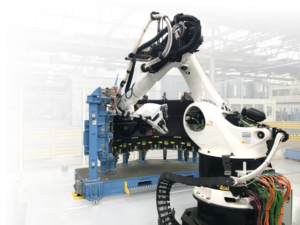 Automation in 2026 is no longer a novelty. It is a baseline requirement for large composite aerostructures.
“Automation is not about speed alone,” Tommy explains. “It is a labour swap and a rate protection strategy.”
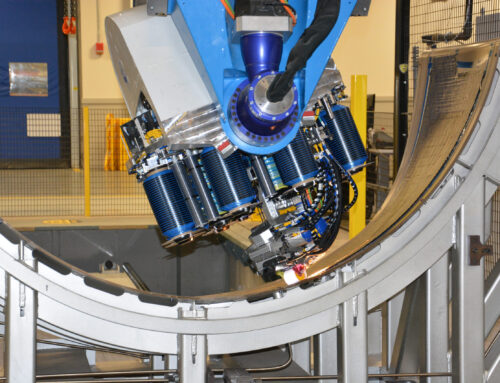
Automated Fiber Placement, robotic drilling and fastening, CNC machining, digital clean room monitoring, and integrated inspection systems are core enablers of rate protection. Large composite structures cannot be produced competitively at scale without them.
However, automation without process redesign fails. Adding robots to legacy workflows without redefining quality criteria, data architecture, and inspection strategy results in capital inefficiency.
Closed-loop manufacturing data is now central. It provides traceability when customers need answers. During smooth production, it may feel secondary. In moments of failure, it becomes indispensable.
Certification Pressure
Certification continues to lengthen rather than compress. Regulators prioritise safety and robustness over manufacturing efficiency.
Digital manufacturing generates enormous data volumes. Managing that data and making it accessible in meaningful ways has become a discipline in itself.
There is a gradual shift toward process control rather than purely end-item inspection. Continuous monitoring, in process verification, and automated inspection technologies are redefining quality systems. Yet regulatory evolution remains cautious.
For composite manufacturers, certification readiness now demands engineering excellence alongside rigorous data governance.
Materials Reality: Thermosets Still Dominate
Thermoplastics continue to attract attention, particularly in applications that resemble sheet-metal-style forming. In specific use cases, the value proposition can be compelling.
However, in 2026, thermosets remain dominant for primary aerospace structures. Infrastructure, certification pathways, tooling ecosystems, and workforce training are built around them.
As Tommy puts it:
“Thermoplastics will work for certain applications. But for primary aerospace structures today, thermosets are still the backbone. The value proposition has to justify the certification burden.”
Until alternative systems demonstrate clear industrial and certification advantages at scale, thermosets will continue to anchor aerospace composite production.
The Workforce Imperative
Perhaps the most urgent challenge is workforce development.
“Working with Composites is a trade,” Mitch emphasises. “It requires rigor, apprenticeship, and long-term training. We spend too much time on product design and not enough time on who will build it.”
Automation raises the skill threshold rather than lowering it. Technicians must understand machine systems. Engineers must understand process integration. Quality teams must interpret engineering-driven specifications.
If aerospace composites are to support the next generation of aircraft programmes, workforce development must become an industry-wide priority. This is a global requirement.
Looking Toward 2030
By 2030, competitive composite manufacturers will likely share several characteristics:
- Standardised, design integrated manufacturing architectures.
- Deep workforce training pipelines.
- High levels of automation embedded from programme inception.
- Robust digital traceability systems.
- Scalable cure strategies that manage capital intensity.
Capital barriers remain significant. As Mitch notes:
“Pressure cure is a capital barrier that most organisations cannot easily overcome. If we were starting from scratch, we would rethink cure strategy from the ground up.”
Ultimately, the next decade will not be defined by incremental material improvements. It will be defined by industrial discipline.
The opportunity is real. Production demand is rising. Revenue potential is substantial.
But composites manufacturing in 2026 stands at a clear inflection point. The companies that recognise the structural realities, invest in workforce, standardise early, and treat automation as infrastructure rather than accessory will define the next chapter of aerospace manufacturing.